


Prolific author and professor Dr. Leonard Sweet, my first academic crush, coined a phrase to describe what it means to live faithfully in a chaotic (and often apostate) culture—the double-ring. Put another way, when we embrace the double-ring, we follow Jesus as if our life depended on it, and we pay attention to the lived experience of people as if our ministry depended on it. We are determined to “taste and see” the full goodness of Jesus, and just as determined to exegete the shifting realities of our cultural ecosystem. We don’t pit the “ring” of the gospel against the “ring” of culture, we hear them as harmonic companions.
Today, the double-ring is pointing me to a strategic opportunity in this cultural moment. In the decade spanning the mid-2000’s to the mid-2010’s, the rise of “New Atheism” made literary celebrities out of “The Four Horsemen”—Christopher Hitchens, Richard Dawkins, Sam Harris, and Daniel Dennett. Millions of people read their books, ingested their polemics, and declared themselves kindred atheists. The percentage of people identifying as atheist rose from 2 percent of the population to 4 percent in just one decade. As cultural observers often do, many predicted a continued linear increase in disbelief. But that’s not what happened.
While the number of “Nones” (those who claim no affiliation with a church) continues to rise, the percentage of atheists has remained flat since 2021. And even those who identify as atheist often acknowledge the reality of spiritual experiences and undefined spiritual realities—a quarter of them believe in some kind of “spiritual force.” Americans, in overwhelming numbers, see themselves as “spiritual” people. They’re simply worn out by the dysfunctions and disappointments they’ve encountered in the church. The message of the New Atheists is that religion is a silly myth served up to unsophisticated people. And many resonated with that acerbic assessment—but not for long… Just as a toddler’s tantrum finally runs out of energy, the New Atheists have all softened their stance, with Dawkins now declaring himself a “cultural Christian.”
Meanwhile, what has this deconstructive movement left in its wake? Purdue University reporter and science writer Nick Pompella, writing in The Dispatch, says: “If the statistics tell us anything, it’s that this phenomenon has evaporated. People aren’t on the whole very enthusiastic about going to church, but most Americans still believe in some kind of god, and we have not been mass-unbaptized as New Atheists… America today, then, seems rife with opportunities for God to seep in.” Pompella points to the rise of “The Four Horsemen of New Theism”—the New York Times columnist Ross Douthat, theologian David Bentley Hart, journalist Rod Dreher, and pagan-turned Christian author Paul Kingsnorth—as the vanguard for a new wave of religious exploration.
I’m actually churning my way through Kingsnorth’s NYT bestseller Against the Machine right now. I first heard him interviewed on Russell Moore’s podcast, and was floored by his take on AI and interactive technologies—he makes the case that these semi-sentient digital entities invite demonic forces as influences in our life. Sounds crazy, but not when you listen to his arguments. And this is coming from a guy who’s lived most of his life as a pagan worshipper of creation, not its Creator. Late in his life he was magnetically drawn to Christian faith, in much the same way C.S. Lewis was dragged kicking and screaming into the way of Jesus. His book is #8 on the bestseller list as I write—indicative of a large swath of Americans who remain passionately curious about spirituality in general and Christianity in particular.
And that brings us to our present opportunity. Jesus said: “The harvest is great, but the workers are few. So pray to the Lord who is in charge of the harvest; ask him to send more workers into his fields” (Matthew 9:37-38). Yes, He’s speaking to followers living in a particular time and place, but He’s also speaking beyond that moment to all of us living in this cultural opportunity. Our churches, on the whole, have seen an exodus of attenders for some time now. But just outside the fringe of our influence is a thick, teaming circle of the curious and the hungry and the spiritually lonely. They are like trees in a forest during a drought—one little spark can quickly spread to a wildfire.
At the close of his piece “Why New Atheism Crumbled,” Pompella says: “American religions still have to reintroduce people into a fruitful, perhaps even difficult religious life dedicated to one institution, with one internally coherent set of beliefs. They will have to contend with this raw spiritual energy and channel it to the right places.” So, what does “channel it to the right places” mean?
- If people are tired of religious talk and long for mystical religious experiences, what is the double-ring telling us?
- If people are disillusioned by the political underpinnings that have infected the church, what is the double-ring telling us?
- If people have lost their trust in religious institutions and religious leaders, and are longing for authenticity and integrity, what is the double-ring telling us?
- If people are worn out by religious duty and religious rule-keeping, and are starved for meaningful relationship, what is the double-ring telling us?
There is a forest of trees just outside our church doors that is dry as a bone—Jesus invites us to toss our matches in that forest: “I have come to set the world on fire, and I wish it were already burning!” (Luke 12:49).
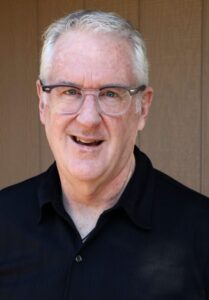
Rick Lawrence is Executive Director of Vibrant Faith—he created the new curriculum Following Jesus. He’s editor of the Jesus-Centered Bible and author of 40 books, including his newest Editing Jesus: Confronting the Distorted Faith of the American Church, The Suicide Solution, The Jesus-Centered Life and Jesus-Centered Daily. He hosts the podcast Paying Ridiculous Attention to Jesus.