

Today I met with the pastor of a small church that, for years, has been struggling to keep its head above water. He took over a dying church and a congregational culture that was, well, so politicized that the gospel itself was overshadowed. I’ve been meeting with this pastor, long since my friend, every month for five years now. He’d read one of my books, and his wife was a participant in one of my workshops—I met him “accidentally” in a Starbucks when he somehow recognized me and asked if he could meet for mentoring.
Over time, I’ve seen the impossible happen in my friend’s church. No, it’s not meteoric growth or hipster influence. The congregation is just as fragile as ever. But in his first experience as a lead pastor, in a congregation that had long known him as their youth pastor, he’s been determined to reclaim and re-plant a Jesus-centered focus. It’s been a long, hard slog… With no conventional “markers” for success. And yet, I told him today, I think his five-year journey with this church is a spectacular success story. Why? These are the three bullet-point observations I offered him today…
- The fourth-soil standard for success – Common consulting advice in the church world targets the mechanics of strategic growth. We’re told to model our leadership after known patterns of growth pioneered by the “it” churches in our contemporary landscape. Yet, I believe, this focus on scaling our numbers, or success that’s based on what we can easily measure, is constantly taking our eye off the ball.
Jesus told “The Parable of the Soils” to plant in us a metaphoric explanation for our growth partnership with Him. In the parable, three types of soil sabotage growth, and one type of soil promotes it. The message of the parable is not about strategic growth models—it’s about the one thing that we can influence in our church culture, and the one thing we can’t influence.
Simply, in the Kingdom of God, the mysterious and hidden growth process is on the Spirit’s job description, not ours. Our job is to enrich the soil that faith-seeds are planted in, giving them the best chance for growth. But we don’t control the actual growing process. When our common strategies all focus on the one thing we can’t control—actual growth—then our attention is diverted from the one thing we can control—enriching the fertile soil of a church culture that promotes “walking in the way of Jesus, with the heart of Jesus.”
I told my friend that he’s been persistently leaning into this flywheel of culture-change, faithfully focused on revealing the beauty of Jesus from many facets. And he’s seeing new buds popping up through the soil. One longtime church member told her sister, who lives in another state, to watch the service online because “what you’re going to see is different from what you expect.” That’s a minor miracle in the face unbelievable odds. - There are no common and repeatable practices that produce growth like a math equation, there is only the organic growth produced by the “branch” intimately embedded in the Vine. John Kay, the British economist and first dean of Oxford’s business school, writes: “The process in which well-defined and prioritized objectives are broken down into specific states and actions whose progress can be monitored and measured [like the Waltz] is not the reality of how people find fulfillment in their lives, create great art, establish great societies or build good businesses.” Anecdotally, it’s easy to find examples that support Kay’s “organic greatness” observation:
– Early in its long run on public television, the producers of Sesame Street heeded the conventional advice of child psychologists and banned the show’s human actors from interacting with the Muppets—the professionals were worried that kids would feel confused by these cross-species relationships. When the Children’s Television Workshop tested the new format they found kids paid attention to the show when the Muppets were on the screen, but lost interest when only the human actors were on the screen. So the producers ditched the recommended advice and decided to follow the organic—and conventionally confusing—approach that later became a central facet of the show’s success. Jim Henson build Muppets big enough to interact with full-sized humans—and that’s how we got Big Bird and Oscar the Grouch, among others.
– John Stuart Mill, a British philosopher who was later one of the fathers of modern social/economic theory and a huge influence in the spread of democracy as a politically superior way to govern, escaped his own prison of depression when he decided that “happiness is attained not by making it the direct goal of life, but by fixing one’s mind on some other pursuit.” He discovered that when he followed his organic passions, happiness was the fruit.
– When Scott Joplin was a child of field laborers in early 20th-century Texas, his father Giles left his mother Florence for another woman, in part because she insisted on continuing to support her son’s music education even though the family needed him to earn supplemental income in the fields. The most direct way to earn income for the family, contended Giles, was to get his son working as early as possible as a laborer. But, instead, Scott’s mom was adamant about the organic path of a career in music, and Joplin later invented a new style of music called ragtime.
- The central value and persistent norm in the culture of God’s Kingdom is quite simple: Tiny things are all the time growing into enormous things that offer sustenance and sanctuary. Our missional calling is to offer the tiny portion of yeast given to us (what we have been called by God to do) in the lump of dough that is our church and our culture, then stop obsessing about the growth that is likely outside our ability to see or record. Jesus intends to plant these the high-level objectives of the Kingdom of God in our souls, like seeds that grow into oak trees in our life. Then he expects us to live out of these high-level objectives in an improvisational, organic way. Paul is describing this way of living his life for Christ when he writes: “But to me it is a very small thing that I may be examined by you, or by anyhuman court; in fact, I do not even examine myself. For I am conscious of nothing against myself, yet I am not by this acquitted; but the one who examines me is the Lord” (1 Corinthians 4:3-4). He’s saying, essentially, that he’s not always checking himself to see if he’s hitting the expected success standards—instead, he lives his life pursuing the “high-level objectives” of the Kingdom of God and trusts the Spirit of God living in him to bring the growth, and alter his trajectory if necessary.
My friend (and, likely you) is faithfully risking the “talent” Jesus has given him, not burying it in field because he’s afraid he won’t measure up. He is doing exactly what Jesus, and the great company of witnesses in His Kingdom, are cheering… right now.
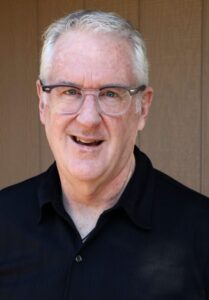
Rick Lawrence is Executive Director of Vibrant Faith—he created the new curriculum Following Jesus. He’s editor of the Jesus-Centered Bible and author of 40 books, including his newest Editing Jesus: Confronting the Distorted Faith of the American Church, The Suicide Solution, The Jesus-Centered Life and Jesus-Centered Daily. He hosts the podcast Paying Ridiculous Attention to Jesus.